
Jack Haven
April 18, 2025
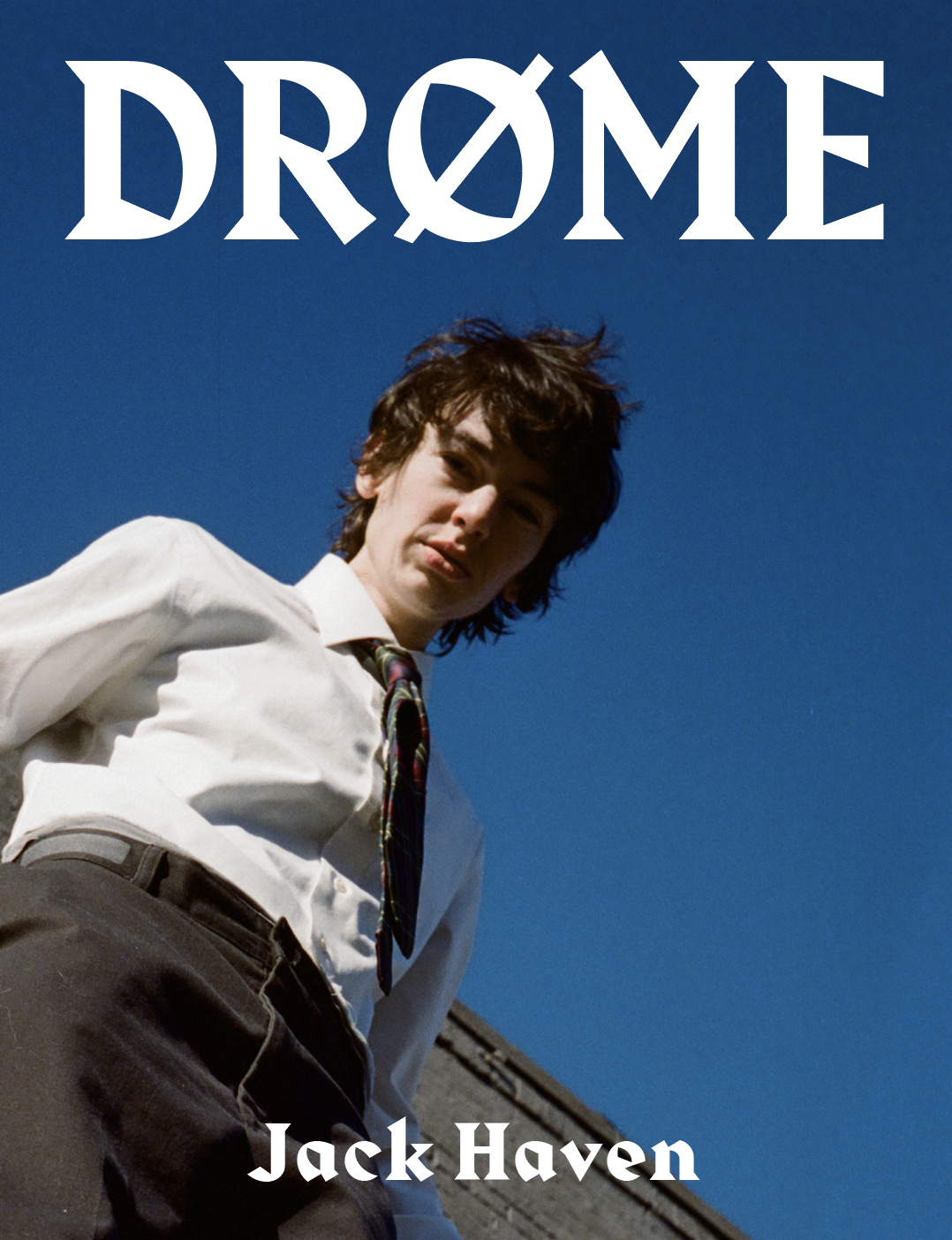
Interview by Leah Wasilewski @lilpolskaa and Caroline D’Arcy @thedarcyshow
Caroline D’Arcy: Talk to us about the math you’ve been learning and how that all came about.
Jack Haven: I started by being curious about Physics and just getting excited watching YouTube videos, such as Leonard Susskind lectures. Then, my friend Peter Nolan Smith, who is my upstairs neighbor — he’s in the movie I made, October Crow, he’s a poet, he’s a wild character — he has been going to the Explorer’s Club and took me there with him. And I randomly met a girl there who’s dad is a physicist and was looking for a student. I had a couple lessons with him and realized I needed to start in the very very beginning. My partner, Luca, their mom is a math tutor so she gave me a book on algebra and trigonometry. I started at the very beginning and I’ve just been working my way through it. It’s just so beautiful because it’s all so perfect. There’s a real answer to everything and that’s really comforting to me because I feel like I’ve been living in abstraction for so long. Knowing the basics of math helps me think more abstractly about the universe, because you can hold in your mind that there are things that are true, for instance, you can always trust a triangle, but also for most things, we have no idea what’s going on and so it’s about understanding both sides of the scale of curiosity.
C: I love that, you can trust a triangle.
J: It’s so nice. Especially when it’s that right angle, a² + b² = c². So sexy. There’s one section in this book that I’m reading — It’s a textbook from 2010 or something. There’s a fun fact in it about the philosopher who discovered irrational numbers. Pythagoras and all his buddies were so upset by this discovery, that they drowned this mathematician because it upset everything they knew about the perfection of math.

Leah Wasilewski: Were you fascinated by math in highschool and when you were younger?
J: I was very distracted with my school. I really enjoyed statistics and I liked the way it worked my mind, but I was so emotional in high school.
C: That’s inspiring me. It’s so cool to learn new things.
J: And it’s really easy to do it. We have all of the tools to learn anything because of YouTube. And Google.
L: I was always encouraged to learn something in order to profit off of it, but it’s cool to learn something for no other purpose than being curious about it. I’m assuming you don’t want to be a mathematician.
J: I do want to be a physicist. No I’m just kidding… It’s so funny— Alex McVicker, I call her my daughter, she’s my best friend. We live together. She always makes fun of me because I want to turn everything into a business. Like we recently started sewing, and I’m already talking about her label and to make tags and she’s like, no you don’t understand I want to do this because I want to learn how to make quality things for myself, but I have such a business mind. The only things that can’t be corrupted for me are whatever curiosities I’m currently indulging in. And painting. That can’t be corrupted for me, luckily. My grandfather was a commercial painter and I think it made him really sad because his private practice was intruded upon. There is a death in that. So, painting is alive for me, and music too. I’m learning the guitar very slowly. Acting is something I have been doing from such a young age, and it was always a business. My parents are actors and so from the time I was auditioning for this community theatre production, they saw the contract and they were like, okay so this is what they’re getting paid, and [the producers] were like, no that is the fee to participate in the play. It was always commercial.

L: Do you feel like that’s self-exploitative too? Acting?
J: Yeah totally. In a way, I think you must exploit a part of yourself. And most people exploit the human relation part of themselves, the customer service part of themselves, the social aspect of themselves. I think most people exploit it in order to build some foundation for themselves. And then some people, for instance Luca’s mom Diane, who is a math tutor, told me she’d do it for me she said, don’t tell the clients but I’d do it for free, which I’m now saying in an interview so now she’s exposed (laughs). She’s being exploited, but it’s always pleasurable, and I think that’s the same with acting. I’m very happy to exploit it because I know I can and because I think there’s endless depth in my ability and understanding of what it is to express different characters.
C: Can you talk about Waif?
J: We started Waif in 2016. I had just done a campaign for Nike and I was getting so much stuff. They were sending boxes of shoes and stuff and it changes your relationship to commerce because you realize that it’s trash nothingness and it all ends up in the trash pile in Chile. Do you know about this? There are miles and miles and miles of fast fashion that is just like an island in itself because it’s gone through three levels of resale and it’s finally sent to Chile and they put it in this pile in the desert. The local people have a whole industry of burning it which of course then releases toxins in the air which of course makes the people get sick…

L: Why Chile, do you think?
J: I don’t know, I think there’s some sort of trade agreement that came by because of excess clothing and of course then its sent to this excess clothing pile in the desert. Waif was a reaction to the death of capitalist ideals. We wanted to start a magazine that was run by these two European pop stars Silver and Smoke who we would play onstage. They thought they understood “trend,” but they actually had no idea what was cool and in fact were always uncool. So that was where it began, as a fake magazine, and I started it with my band at the time. We were an improvisational voice band and we’d do performance art, a lot of which was improvised. A lot of it was stock characters, like these pop stars and there was a set of American DJ’s; one was completely silent and they would kiss at the end of their set or cut each other’s hair. Then it became about community. Waif was something that we could share with other artists we respected. But at the foundation of it was this definition from a dictionary from 1893 that “waif” means anything found without an owner. So, Waif embodies the idea that you are uncorrupted and unowned by the forces of trend and advertising. Your mind is not being twisted to fit some ideal of fashion. You have everything you need.

L: What about fashion as an art form when you erase the consumerism attached to it?
J: Right and as a historical portal too. I was just watching this old series with Vivienne Westwood, Painted Ladies; she talks about how all of her inspiration comes from going to museums and looking at paintings and how the fabrics fall, that the foundation of painting, or of classical painting, is drapery. So she talks about how the drape falls and about capturing the movement of fabric.
L: That’s like Alexander McQueen.
J: He’s another one. A great designer is a great artist. They make you understand both your place in history and its timelessness, but also the adoration of the body. I think that’s a very different thing from the industry of fashion, just like most art forms are different from the industry they exist in. Great art is always respecting and challenging the tension of its own industry. It’s always failing in a way. That’s how it stretches the limits of its industry. You have to be faster than capitalism because capitalism will always catch up with you.
L: It’s interesting to hear you speak about this because you’re in the acting industry but you’re speaking about it in a way that’s so mentally removed from it too. I feel like that’s a strength that a lot of other people lack because when you’re in something, you’re so in it that you can’t see past it.
J: Yeah. It’s really hard to see past it. For a long time I was so unhappy because I was drowning in the curse of, now I’m in it and there’s no way out, which is what Waif was, it was saving me from that. There is another avenue. I was so misunderstood for so long, because people didn’t know how to cast me, but I’ve let go of trying to explain myself and I better understand now that it’s like a tide that’s always moving and you can sit back and watch it and enjoy the rhythms of it.
C: How do you gain that perspective?
J: I really think it’s just by failing. I’ve also been listening to Daniel Johnston recently for the first time. He was a self-recorded musician who started making tapes in the 80’s. He worked at McDonald’s and he would pass [the tapes] out. His songs are very simple and childlike, but really deeply true. He sings about being lonely and being sort of like this baby who is supported by an angel. He inspired everyone, like Kurt Cobain was obsessed with him. He made a lot of art and a lot of it was these alien characters. I was looking at one of them this morning and it said, “It’s easy to succeed, it’s harder to fail,” and I think that’s part of it, like, you have to have the bravery to reject your own ability to succeed. You have to constantly be rejecting that because it’s just never gonna be what sculpts you to who you are.
L: What kinds of roles were you trying to stay away from before, and what is your ideal role now?
J: When you first start as an actor you’re like a picture of a person and people are chiseling away at you, and I was not interested in what my picture was and the roles the picture represented didn’t make sense to me. Now, I have so much opportunity and I am so grateful for it because of TV Glow and because of Jane [Schoenbrun] and because of being able to play a character who buries themselves alive and was reborn. That is what I wanted to do and I knew I would be able to by doing TV Glow. I didn’t know quite how extreme the vulnerability of sharing that movie with the world would be, but I feel so grateful to have gone through that and now on the other side of that, I feel so free.
When you are giving yourself wholly to a story and it’s coming from your deepest gut of self and you’re throwing your animal flesh up against that machine, you have to be ripped up and churned by it, by the questions that don’t make sense, by the agreement with the war machines that are ripping up our planet. That is what is at the foundation of every industry film, and I Saw the TV Glow is not excluded from that, so I think I was confronted with the violence and it felt hard to make the sacrifice personally of realizing what this vulnerability is being lended to — it’s being lended to this war machine.

L: So something larger than the film itself.
J: Yes, and it’s a deeply painful truth about capitalism — the greater the exposure, the truer the thing, the more violently it will be consumed, because it’s a threat. The movie that Jane [Schoenbrun] made denies all of the principles of this industry. The industry is really built on the single image of a white European ideal of beauty, like Marilyn Monroe. And if you try to attack that either you win an Oscar or you’re ignored, but if enough people feel it’s true to them, it’s just contending with the machine. What it felt like to go to festivals and be interviewed about the movie and talk about it with that machine, it felt like meeting an army with that enemy like we were confronting the enemy, and the enemy was wanting to destroy us and find some chink in our armor at every point. But also, the movie has something in it and Jane has some way of turning a story so that it can’t be destroyed. I felt that way with TV Glow, that it was too real it couldn’t be destroyed.
L: What do you mean?
J: It just couldn’t be swallowed. I think there are ways we tell stories that feel like they’re an attempt at radical storytelling, but there is a compromising in them and there is no compromising in TV Glow I think.

C: Was it difficult to transition from being on set and having a cathartic experience to then being out in the real world?
J: Yes. I had a gap of a year in between, and in that time I started taking hormones. I went into a really deep, dark place. My friend Peter almost died, he got a liver transplant and ended up just being me taking care of him after, and it was such an intense time. And then going through the festival circuit… I learned a lot and then it got easier and easier. Now, I don’t really care about any of that, because I’ve done it already. If I had to do it again, I’d be so light hearted and I’d be able to express myself without anger, because seeing it up close you see its violence but you also see its innocence. Like any great beast, you get up close to it and it’s hurting too, it’s all just people who are just curious and want to be loved and probably want to be famous.
L: Confronting that just with empathy like you’re suggesting is important, but do you think confronting it with anger is necessary too?
J: Well, I always think about two things when I think about anger. One is Great Thunberg saying that she’s never angry. She says she speaks with passion but she’s never angry. And I also think about this great book, “Many Lives, Many Masters,” which is about a past life therapist and his experience with a woman who is recalling her past lives. She speaks about meeting these beings called “the masters.” They tell her that our souls are never tired and never angry. So, I think anger is something we can use as a motor. There is so much to be angry about, but I think we also need to remember to lean into the softness of eternity. There is a really long way to go, and we’ve come a really long way, so there’s no reason to burn a fuse the way it sometimes feels easy to do.
L: That’s interesting you equate being angry to burning a fuse.
J: It’s hot. It’s like a candle. Like anything that’s burning, it burns down and then there are ashes and then they get cold. I think you have to have a passionate fire like the eternal fire, that’s what the spark, that’s what all religions are about — the spark of this human magic. That’s what the cross is, the cross of spirit and body, and at the center of it is the spark and it turns.
C: How do you think you’ve changed since you were in DRØME in 2019?
J: I wrote about celebrities and seeing Tom Cruise in a magazine or something. My friend Gabriel who is a director and good friend, he always makes fun of me because he’s like, you’re obsessed with celebrities even though you talk about rejecting them all of the time, and I think it’s because I’m obsessed with myth. I think if I were to write something for DRØME now, it would be really different.

L: I would love to see what that would be and the difference.
C: In what ways do you feel your acting practices have changed?
J: Well actually, I don’t really know because I think all of the projects I have coming now are waiting for a budget so I don’t know how it’s going to be to work faster and play lots of different characters. I’ve always had the privilege of spending a lot of time with a character. I want to do a show where I’m playing a lot of characters because when I’m alone I’m always playing characters and talking to myself as different characters, so I think I want to make my practice more nimble.
L: Do you work with an acting coach?
J: No. I’ve been to a couple [of coaches] with actors I was working with, when they had one, and it’s fun but I have a really lonely process of total immersion with myself and I have to be in the world with it alone before I can be there with other people.
C: What does that look like for you?
J: Imagine you’re watching a little kid play in the backyard and there is a whole world you can’t see. That’s usually what it feels like. Playing “kitchen”.
