
Danny Bowien
February 28, 2019
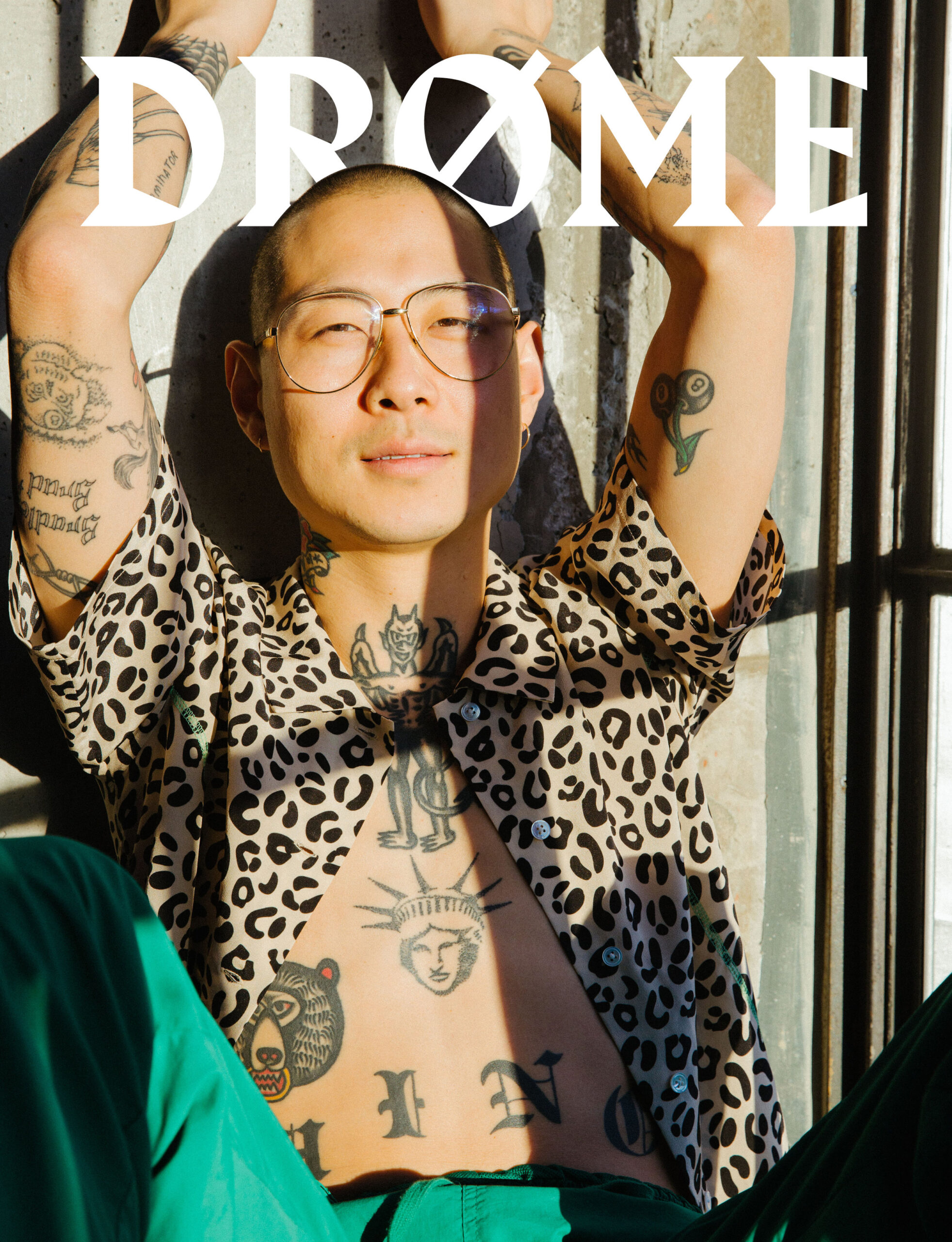
Photo Matteo Mobilio
Interview Slater Stanley
Styling Danny Bowien
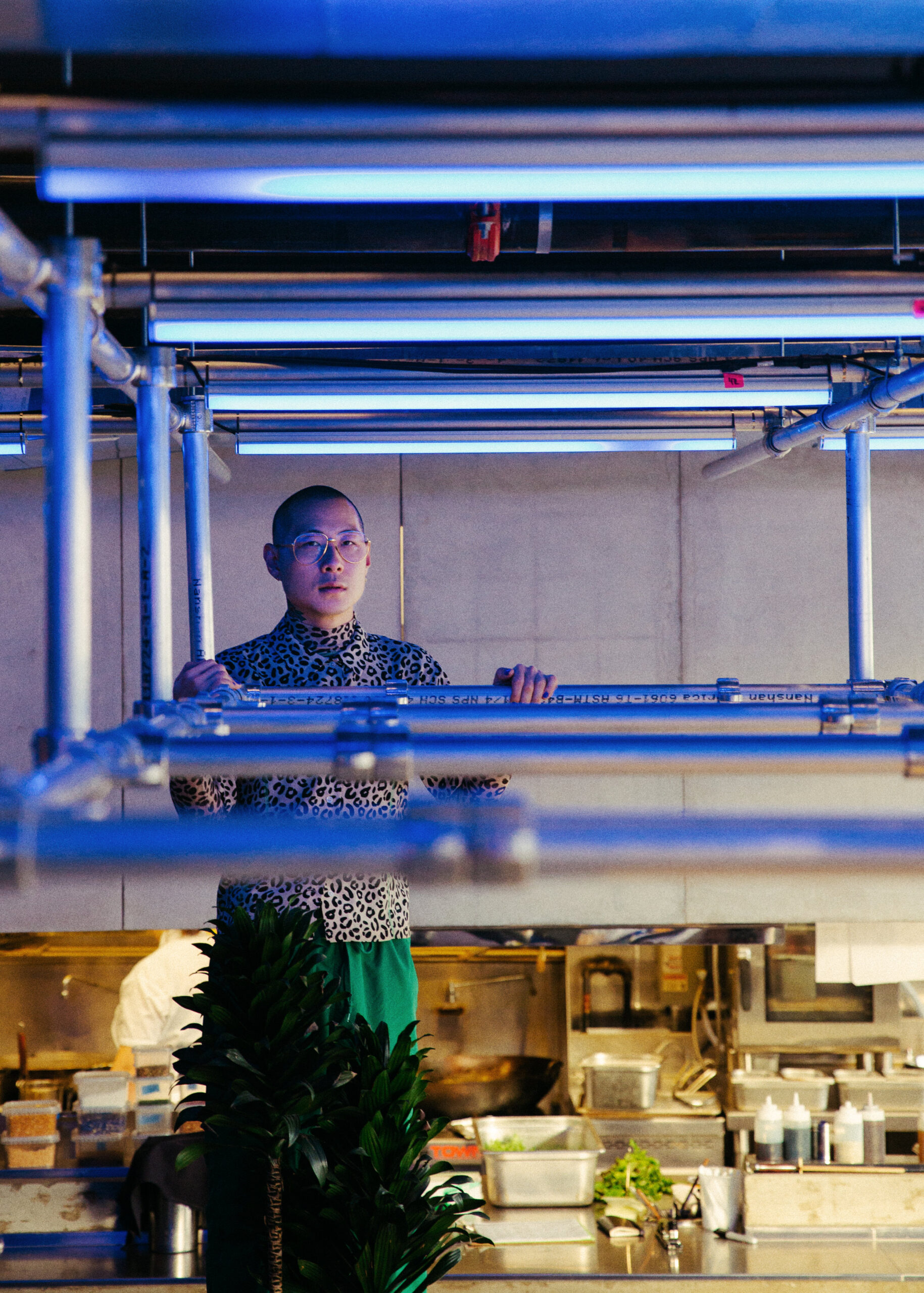
What really drew me into Mission Chinese was all the lights. It looks like a club in there! What is the relationship for you between nightlife and food?
Restaurants for me, have a level of escapism. Going out to a meal is just like going out for a night out.
I noticed that it has a lot of neon lighting and is super spacious. Did you have a hand in the interior design?
We were fortunate to be able to work with some really creative people who realized our vision, Alex Gvojic, Lauren Devine, and Nikki Mirsaeid. We wanted the restaurant to be indicative of its Bushwick surroundings, so it definitely has a brutalist and industrial feel. Our first restaurant on Orchard Street was tiny. That lasted a year and a half, and then we had to move. The Chinatown location is much bigger. It was interesting and fun to have gone into this new space, because we got to build it from the ground up.
There is a very palpable feel of Bushwick in the restaurant, it’s very youthful and light hearted. I visited the Mission Chinese in Manhattan which is like the older sister to the Bushwick location. Do you have any plans for opening another location?
Right now Bushwick is only four months old, so there has to be a lot of attention and time put into its development. I have lots of hopes and aspirations to open up more locations and do more projects. Right now my time is dedicated to operating both locations, which is a lot. I tend to thrive in chaotic environments and when I have lots of things on the table. So ideally we would be doing a lot more.
Your son is adorable and is all over your Instagram which I think grounds you for your audience; more than a mastermind chef, you are a relatable human being. From the ingredients in your dishes, you seem to view food with a childlike curiosity. How does your son inspire you in terms of cooking?
My son is starting to like spicy food. For the first couple years, I found myself eating a lot of food I was preparing for him— very simple, clean flavors, and things that aren’t spicy or overwhelming. That was informative of the Bushwick location. A lot of dishes adopt the less-is-more approach. Cooking for my son has definitely informed how my cooking style is evolving into a more health conscious and simplistic approach. At Bushwick, we have really dialed down the amount of meat we serve, leaning a lot more towards vegetarian, even vegan-based.
Yes, I so appreciated that. I am a vegan myself.
As a chef, you can lean on certain ingredients, but it’s fun to challenge yourself in other ways. Like, what can I do without putting pork belly or bacon into this dish? Also the demographic, and demands of Bushwick clientele versus lower Manhattan has been a really great challenge, and I’ve embraced it.
Your son and I both have a lot in common; we both have mullets and we both love spicy food! You were talking early about sources of inspiration. I see you doing work in fashion, and other fields aside from cooking. How has Instagram affected the way you interact with your customers as well as collaborate with other creators?
Social media has changed everything. When I was starting to cook, there was a mystique to it—you’d hear about a dish this chef was doing in Spain, and you’d have to go seek out a cookbook. Then you’d lust after it, because cookbooks were really expensive, and you’d hang out at cookbook stores. Now, everything is so accessible which is really helpful. But the good thing about food is that you can’t download it. You still have to go eat it. Social media has definitely helped broaden our reach, but it can be depressing. Everyone is always presenting their best case scenarios. I use social media lightly and don’t take it too seriously. Most of the pictures are of me and my son doing silly stuff, or food.
Your whole Instagram has such an air of softness, which is very comforting.
I’m 36 now, and I’ve been through a fair amount since moving to New York seven years ago. I feel like there has to be lightness in everything for me at this point. I’ve had insane opportunities because of social media, but I do find myself taking time to disconnect from Instagram. I grew up in Oklahoma, and when I was younger the only access I had to food was through watching stuff on TV, like Food Network. I don’t follow a lot of food-based people on Instagram; I tend to follow people who inspire me or silly stuff that makes me laugh.
That’s a great way to not get sucked into the spiral. You are very vocal about your sobriety. How has your life and the food you create been affected by that decisionI haven’t drank for about 6 years. When I stopped drinking I was still self medicating in different ways, with drugs or prescription drugs. I woke up one day and realized that I hadn’t been sober for the last 18 years. Every night I felt like I had to drink to go to bed; the industry I worked in was very demanding and I got tired of being hungover. I had to get a handle on my life and my business. At the time when we were blowing up, I couldn’t have been more unhappy personally, but to everyone else it looked like I was on top of the world. After becoming successful, you think you have to live up to a certain expectation. It was really difficult for me to break out of that mindset. Sobriety has helped me become less fearful of success. It’s improved my cooking too, because I used to be high all the time, and I used to think I had all these cut great and amazing ideas, but I was just high.
At work, every day there is a challenge. The dishwasher is going to be broken, you’re going to have a leak somewhere—whatever it is, it’s about recovery, not running away from problems. You can’t close the restaurant because the dishwasher isn’t working, and so you have to look at it in the face and walk straight through it. I was so terrified to fall down. People want to make it seem like they’re living their best life and everything is great and that’s just not reality. Things happen. I have fallen down but I’ve gotten back up, and continue to push on. You learn from your mistakes. Failure is probably the most important part of success. [Recovery] helped me get to the place where I’m not afraid to get up and move on. Every day is a new day.
I want to congratulate you on that milestone. You have articulated the clarity it has obviously given you. From my experience working in kitchens, I’ve noticed that many cooks are heavily tattooed. Do you think that has to do with escapism and catharsis?
I grew up in Oklahoma, and when I still lived in Oklahoma it was illegal, you couldn’t legally get tattooed.
Oh my God.
I just got back from Oklahoma and I got a tattoo there because it’s legal now. Tattoos are another from of expression. A tattoo is an example of something that’s really painful, that you push yourself to get through— it’s challenging. I usually get tattoos that take a few hours, and there is a level of spontaneity sometimes. I just got a tattoo of the logo of a chicken fried steak sandwich restaurant in Oklahoma, “Del Rancho.”
Oh, that’s cute.
After opening Bushwick, I feel like I got probably five or six tattoos within six months. I also base them around celebratory times. I’ll do an event with a friend in from out of town and then afterwards I’ll say, “We should go get a tattoo together!” It’s fun. I don’t take it too seriously.
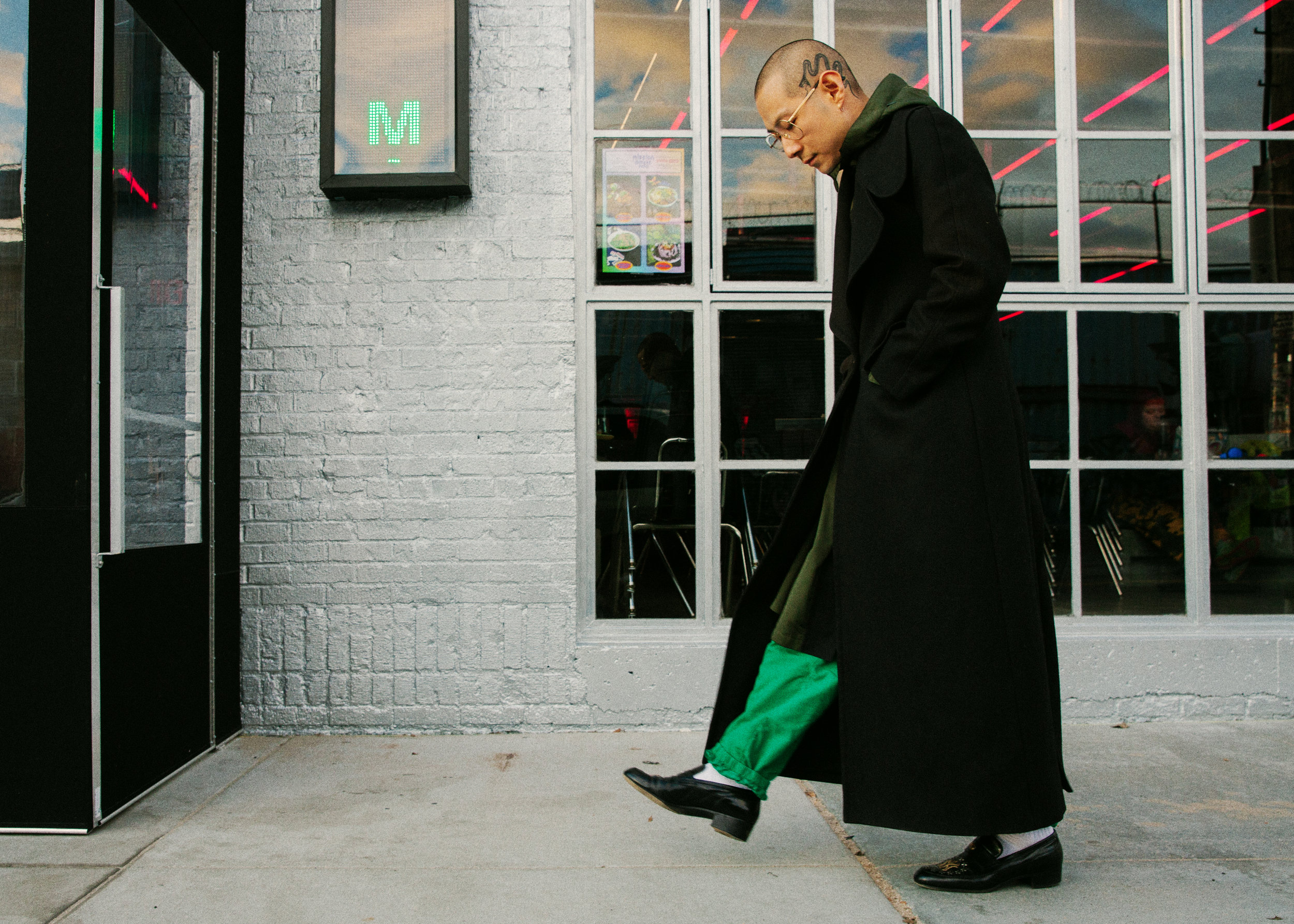
Rad. I can relate. How did you start cooking and why did you choose to focus specifically on Chinese cuisine?
I chose to focus on the food that I really enjoy eating. I was adopted when I was three months old, my parents are American and I’m South Korean. I grew up in a religious household and we went to church five days a week. When people asked what I wanted to do, I always said I want to be a doctor or an eye doctor. So I worked at eye doctor’s offices throughout high school. I didn’t want to go to college, I joined a band. When I was 19, I had to make a move. My friends lived in San Francisco and told me about a culinary school there. And so I used that opportunity to get out of Oklahoma, and entered a very formative time in my life. I partied so crazy in San Francisco eventually I needed to move, so I moved to New York and worked for fine dining restaurants. Then I caught the cooking bug. It wasn’t so much the food as it was the chaotic environment that I was in all the time— having so many pots on the stove at once, so to speak.
I couldn’t afford to live in New York so I moved back to San Francisco. There I found myself cooking at all these really fancy restaurants– it was pristine, precise, and delicate but on our days off, we would go eat insanely spicy Szechuan food. I didn’t want a fine dining restaurant; I wanted a place that felt a little more democratized. I grew up eating fast food in Oklahoma and eating at Chinese restaurants. The first Mission Chinese restaurant we did was a pop-up take-out restaurant. You don’t even notice it if you walk by, and I love how it blended in. So I ultimately got into Chinese food by making Szechuan food. The real challenge of cooking Szechuan food is finding that balance between the spice and saltiness of the food. I love that challenge.
All that optometry practice explains the detail you regard your food with.
Totally.

In the wake of Anthony Bourdain’s passing this last year, many chefs were moved to share what he meant to them. What has his legacy meant to you?
My first job in New York, I had no idea how to work in kitchens — I was just out of culinary school — and I got caught reading a book while I was working…
The nerve!
My chef was like, “What are you doing?” I said, “I’m sorry, I’ll put it away.” Then I showed it to him and he said, “Oh, that’s a really good book.” I was terrified of my chef at the time, but we actually connected over that book, Kitchen Confidential, which I read cover to cover. I was really a fan of Anthony Bourdain’s writing even before I even started watching him on TV. The first time I met [Anthony Bourdain], someone had reached out to us in San Francisco, and there was a show at the time called The Layover. The premise was, he was in a city for 24 hours when he had a layover, and would reach out to chefs in the city and to show him around.
[Anthony Bourdain] asked me to be on the show, so I met him, and took him to all the places I like to go. I was terrified but he made me so comfortable around the cameras. The thing I remember about him the most, was that night, we went to six or seven locations to film. News got out about where he was and the next stop we’d go to, we would show up and more and more people would be there, just watching. At every location, he would stop and hold the production crew up and say hi to every single person and shake their hand. The producers asked me to try to get him to move on to the next location because he would engage with everyone. There was such a personable feeling and warmth about him. He was larger than life. I would always get nervous to hang out with him even as a friend, but whenever we were together everything just stopped, you had his attention. He helped publish my first cookbook. Anthony Bourdain made a point to be present during the moments you had with him. I remember one of the last things we did when we filmed our show Mind of a Chef, there was a party. No one expected him to stay more than 10 minutes, but he stayed the entire time. He surprised us so many times… One time he brought Iggy Pop to Mission Chinese. That was the first time I’ve ever seen him nervous. A lot of times with celebrities, you feel like you don’t want to take their time, but that was never the case with him. I remember his warmth, how genuinely connected he was whenever we would speak.
Well thank you so much for your warmth and time today.
